Governance Philosophy
Leading with Integrity. Serving with Stewardship. Building Institutions That Endure.
Strong institutions are not sustained by good intentions alone. They endure because they are governed with wisdom, integrity, accountability, and a steadfast commitment to the common good.
At Pathfinders Empowerment Network (PEN), governance is not merely an administrative function. It is an expression of our values and an essential instrument for advancing our mission.

How authority, oversight and delivery are separated
The General Assembly elects the Board of Trustees. Seven standing committees carry specialist oversight. The Chief Executive and executive management implement Board decisions and report back.
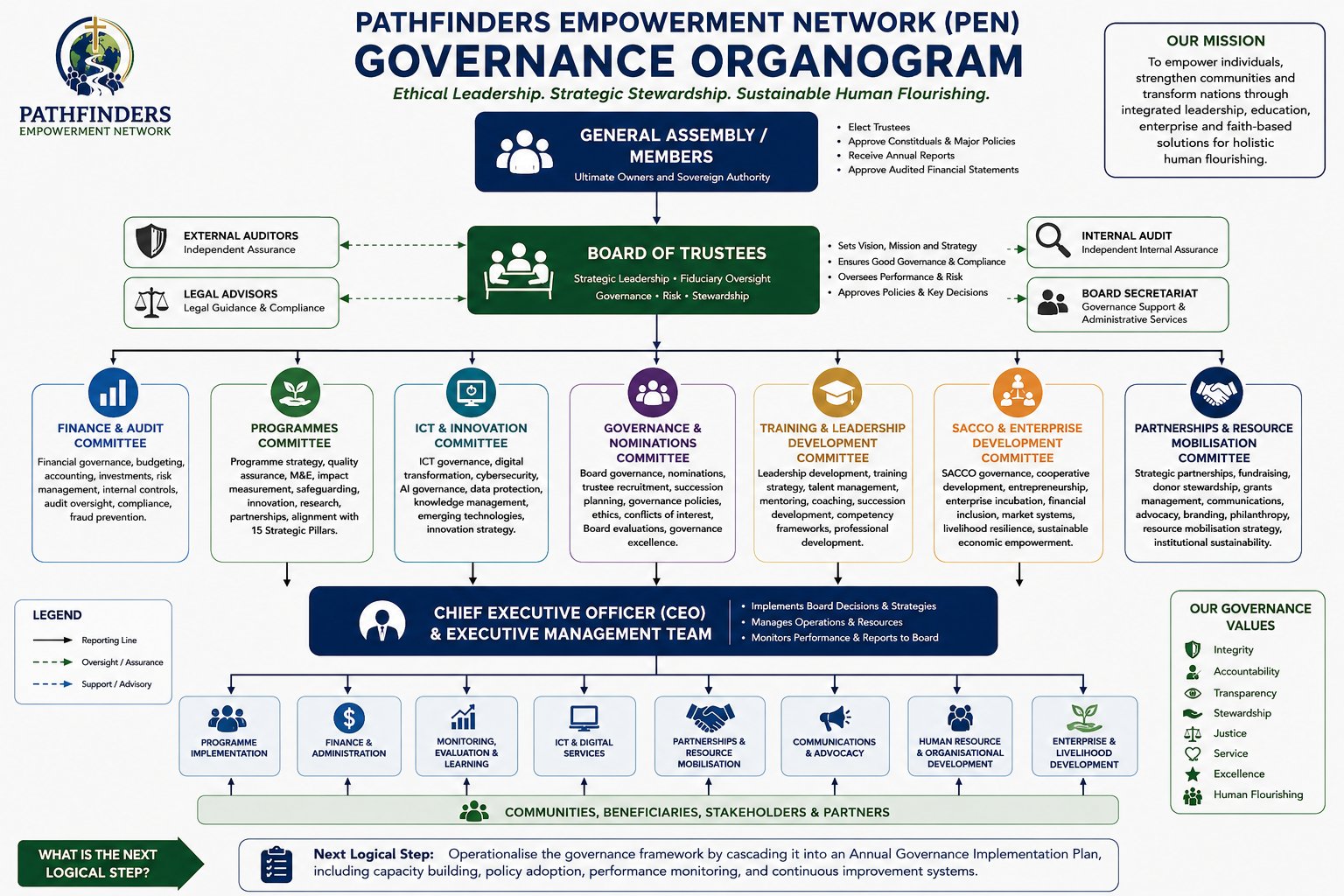
PEN Governance Organogram — ethical leadership, strategic stewardship, sustainable human flourishing.
A Signature Reflection
Institutions Shape Generations
History is shaped not only by remarkable individuals but also by the institutions they build.
When institutions are guided by integrity, they outlive their founders, inspire public confidence, preserve shared values, and continue serving future generations.
When governance is neglected, however, even the most inspiring vision can gradually lose direction.
Leadership becomes personalized.
Resources are mismanaged.
Trust is diminished.
Opportunities are lost.
For this reason, PEN views governance not as bureaucracy but as stewardship.
Good governance protects vision.
It strengthens relationships.
It safeguards public trust.
It creates stability during change.
It ensures that today’s decisions contribute to tomorrow’s flourishing.
Our governance philosophy is therefore inseparable from our mission of developing ethical leaders and strengthening institutions.
Stewarding Vision Through Responsible Leadership
Every organization eventually encounters moments of growth, transition, opportunity, uncertainty, and change.
During such moments, governance provides the framework that enables institutions to remain faithful to their purpose while responding wisely to new circumstances.
At PEN, governance exists to:
- Preserve the organization’s founding vision and values.
- Promote ethical leadership at every level.
- Encourage responsible stewardship of resources.
- Strengthen accountability and transparency.
- Support sound strategic decision-making.
- Protect institutional integrity.
- Foster organizational learning and continuous improvement.
- Build confidence among members, partners, supporters, and the public.
Governance is therefore not an end in itself. It is the means by which mission, values, and long-term sustainability are translated into consistent organizational practice.
Everything Entrusted Must Be Managed Faithfully
Stewardship is one of PEN’s defining convictions.
We believe that every resource entrusted to an organization carries both opportunity and responsibility.
These resources include:
- People.
- Time.
- Knowledge.
- Relationships.
- Financial resources.
- Physical assets.
- Natural resources.
- Public trust.
- Institutional reputation.
- Future opportunities.
Stewardship requires more than efficiency.
It calls for wisdom, integrity, accountability, prudence, generosity, and foresight.
We therefore seek to cultivate a culture in which resources are managed not merely for immediate benefit but for the long-term flourishing of future generations.
Authority Exists to Enable Others to Flourish
PEN embraces a philosophy of servant leadership.
Leadership is not understood primarily as status, privilege, or control.
It is the responsibility to create conditions in which people, organizations, and communities can thrive.
Accordingly, leaders are expected to:
- Model ethical conduct.
- Demonstrate humility.
- Listen before directing.
- Encourage participation.
- Develop future leaders.
- Resolve conflict constructively.
- Make principled decisions.
- Steward resources responsibly.
- Build healthy organizational cultures.
- Place the mission above personal interest.
Leadership gains legitimacy not from position alone but from character, competence, and faithful service.
Trust Built Through Transparency
Trust is earned through consistent integrity.
PEN is committed to accountability in every aspect of organizational life.
This includes accountability to:
Members
Through meaningful participation, responsible leadership, and faithful service.
Partners
Through transparency, collaboration, and mutual respect.
Communities
Through responsiveness, ethical conduct, and measurable impact.
Supporters
Through responsible stewardship of financial and other resources.
Staff and Volunteers
Through fairness, respect, professional development, and shared responsibility.
The Public
Through openness, legal compliance, ethical practice, and responsible citizenship.
Accountability is not merely about reporting outcomes.
It is about honouring relationships and sustaining confidence over time.
The Foundation of Institutional Credibility
Integrity is not one value among many.
It is the foundation upon which every other value depends.
Integrity requires consistency between what an organization believes, what it communicates, and what it practices.
For PEN, integrity includes:
- Honesty.
- Ethical decision-making.
- Responsible stewardship.
- Transparency.
- Fairness.
- Respect for human dignity.
- Faithfulness to commitments.
- Compliance with applicable laws and regulations.
- Responsible management of conflicts of interest.
Institutional credibility grows when these commitments are consistently demonstrated.
Pursuing Quality in Everything We Do
Excellence reflects respect for those we serve.
PEN therefore seeks excellence in:
- Leadership.
- Programme design.
- Learning.
- Research.
- Partnerships.
- Governance.
- Financial management.
- Communication.
- Monitoring and evaluation.
- Continuous improvement.
Excellence does not imply perfection.
Rather, it reflects an ongoing commitment to learning, adaptation, innovation, and faithful stewardship.

Continuous Improvement as a Culture
Healthy institutions remain teachable.
They evaluate their work honestly.
They learn from experience.
They welcome constructive feedback.
They adapt responsibly.
PEN aspires to cultivate a culture in which learning is embedded throughout organizational life.
This includes:
- Strategic reflection.
- Programme evaluation.
- Leadership development.
- Knowledge management.
- Research.
- Innovation.
- Mentorship.
- Succession planning.
- Institutional memory.
Learning enables organizations to remain relevant while remaining faithful to their mission.
Values That Guide Every Choice
Difficult decisions are inevitable.
Our aspiration is that every significant decision reflects principles rather than convenience.
We therefore seek to ask:
- Does this advance our mission?
- Does it respect human dignity?
- Is it ethically responsible?
- Is it a wise use of entrusted resources?
- Will it strengthen public trust?
- Does it contribute to long-term flourishing?
- Does it promote justice, fairness, and inclusion?
- Is it consistent with our values?
These questions help ensure that organizational decisions remain aligned with PEN’s purpose.
Building Institutions That Outlive Individuals
Enduring organizations prepare intentionally for the future.
PEN therefore values governance practices that strengthen institutional continuity, including:
- Strategic planning.
- Leadership development.
- Succession planning.
- Knowledge transfer.
- Financial sustainability.
- Risk management.
- Organizational resilience.
- Partnership development.
- Documentation and institutional memory.
Our aspiration is to build an institution that remains faithful to its mission across generations.
Governance Belongs to Everyone
Although governance includes formal leadership structures, it is ultimately sustained by organizational culture.
Every member, volunteer, employee, partner, and leader contributes to the quality of governance through everyday choices.
Good governance is strengthened when people:
- Honour commitments.
- Communicate truthfully.
- Respect one another.
- Steward resources carefully.
- Welcome accountability.
- Resolve differences constructively.
- Continue learning.
- Serve with humility.
- Pursue excellence.
Institutional culture is therefore one of the most important expressions of governance.
Looking Forward
As PEN grows, its governance structures will continue to mature in response to changing opportunities and responsibilities.
While structures may evolve, our governing principles remain constant:
- Integrity before influence.
- Stewardship before ownership.
- Service before status.
- Accountability before recognition.
- Collaboration before competition.
- Sustainability before short-term success.
- Mission before personal ambition.
These principles provide continuity while allowing the organization to adapt wisely to future challenges.
Our Enduring Commitment
We believe that the strength of an institution is measured not only by the significance of its vision but also by the integrity with which it is governed, the wisdom with which it is led, and the faithfulness with which it serves others.
This conviction shapes every aspect of governance at Pathfinders Empowerment Network.
Governance is stewardship
We hold ourselves accountable to our members, partners, supporters and the communities we serve.